


ADAPTATIVE REUSE FOR DWELLING. THE ACAR ENSEMBLE IN GETAFE
- International Athens Workshop 2026 - Universidad Politécnica de Madrid - U.P.M. - Escuela Técnica Superior de Arquitectura de Madrid - E.T.S.A.M
In Colaboration with: Ayuntamiento de Getafe
Silvia Alonso de los Ríos (Pr. U.P.M.)
Pedro García Martínez (Pr. U.P.C.T.)
Íñigo Lacosta Colorado (PhD, Visiting Researcher)
Raquel de Lucas Matilla (Visiting Researcher)
Published by Portal Científico UPM - 28/07/2026




INTRODUCTION
Published by Portal Científico UPM - 28/07/2026
The journey into the architecture of pre-existence begins not at the drafting board, but in the attentive gaze directed toward everyday life. It starts with the realisation that daily objects are vessels of infinite metaphors; a diary of observation reveals that fundamental elements, such as windows, doors, and floors, are frequently manipulated by the user, becoming "things" that reclaim their essence when stripped of their original function. By observing a stone propped against a door or cardboard replacing glass, we discover the poetics of the "ready-made" and the value of spolia: recycled fragments that transport collective memory across centuries without needing philosophical justification. In this first stage, the architect learns to value the "temporarypermanent," those ephemeral urban solutions that, paradoxically, define the city's eternity.
Sharpened perception then leads us to confront the mystery of the ruin within the ACAR ensemble. Before physically profaning its interior, we approach it through the "unreal imagined". Like Peter Zumthor dreaming of baths he never visited, we reconstruct an interior atmosphere of emotions, shadows, and the scent of what once was. Through an atmospheric section, we capture the synesthesia of the space: light filtering through cracks, the texture of peeling walls, and the latent life in the accumulated layers of time. It is an emotional reconstruction where drawing becomes a tool for empathy with the void.
With the atmosphere fixed, the space is mentally inhabited through ritual. Following Bachelard, we see the house as our "first universe"; to possess it, we must root ourselves through daily acts. We select a building fragment and allow a protagonist to perform a ritual: smoking on a balcony, sitting on a windowsill, or repeating a craftsman's gesture. Each movement is a "micromotor fluctuation" mapped with precision, analysing how the body dialogues with matter and how a new architectural detail articulates this choreography of daily life.
The definitive encounter occurs through exploration of the physical substratum. Much like the secret partitions of Chichikov’s box, we perceive ACAR as a settlement of hidden treasures and corridors to be decoded. On-site, we collect clues through frottages, casts, and sound recordings.
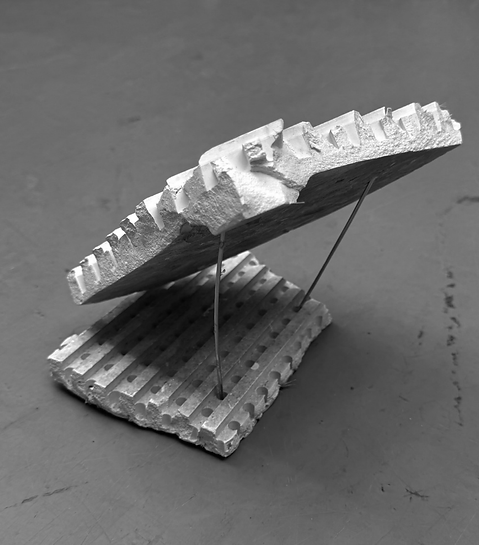
This culminates in an object-manifesto, a tactile piece that condenses our philosophy on reuse, acting as a bridge between the found and the new.
Finally, the process reaches spatial clarification. The rituals expand into a complete program, challenging the "thinness" of traditional briefs that ignore the cultural weight of inhabiting. Like in Dogville, where space is defined by action, we ask how interventions merge with the inherited substratum. The climax is a 1:20-scale dwelling model in which the "joint" between the new and the old becomes tangible. Design here is the organic growth of rituals that, like seeds, find their place in the cracks of pre-existence.
Authors:
- Silvia Alonso de los Ríos (Pr. U.P.M.)
- Pedro García Martínez (Pr. U.P.C.T.)
- Íñigo Lacosta Colorado (PhD, Visiting Researcher)
- Raquel de Lucas Matilla (Visiting Researcher)